Advanced Home Automation System using ESP32
A fully local ESP32-based home automation system — control four appliances over Wi-Fi through a browser, with DHT22-driven automatic fan control and real-time LCD status feedback. No cloud, no app, no subscription.
About the Project
Designed and built during the 2nd semester of Computer Engineering at Kathmandu University. The ESP32 hosts an HTTP web server directly on the local Wi-Fi network, allowing any browser-connected device to toggle four relays and monitor appliance states in real time. A DHT22 sensor continuously reads temperature; when it crosses a configurable threshold, the fan relay switches on automatically without any user intervention. A 1602 I2C LCD mounted on the board displays live appliance status at a glance — no phone required. All control stays entirely on the local network with no dependence on third-party cloud services, external apps, or paid subscriptions.
Key Engineering Features
Web-based control of four appliances over Wi-Fi from any browser on the local network
DHT22 temperature sensor with configurable threshold for automatic fan relay switching
1602 I2C LCD displaying real-time appliance status without needing a phone or app
Fully local architecture — no cloud services, third-party apps, or subscriptions required
HTTP server hosted directly on the ESP32 serving a custom HTML/CSS control interface
I2C communication between ESP32 and LCD for clean, minimal wiring
Hardware & Microcontrollers
Key physical modules, sensors, and IC components integrated:
- ESP32 Dev Module (Wi-Fi + GPIO)
- 4-Channel 5V Relay Module (appliance switching)
- DHT22 Temperature & Humidity Sensor
- 1602 I2C LCD Display
- Power supply & connecting wires
Software & Protocols
Firmware libraries, communication protocols, and control stacks:
- Embedded C/C++ (Arduino Framework)
- HTML/CSS (web control interface)
- Wi-Fi (802.11 b/g/n)
- HTTP
- I2C protocol
Project Gallery & Prototype Views
Snapshots, schematics, and functional bench tests for Advanced Home Automation System using ESP32.
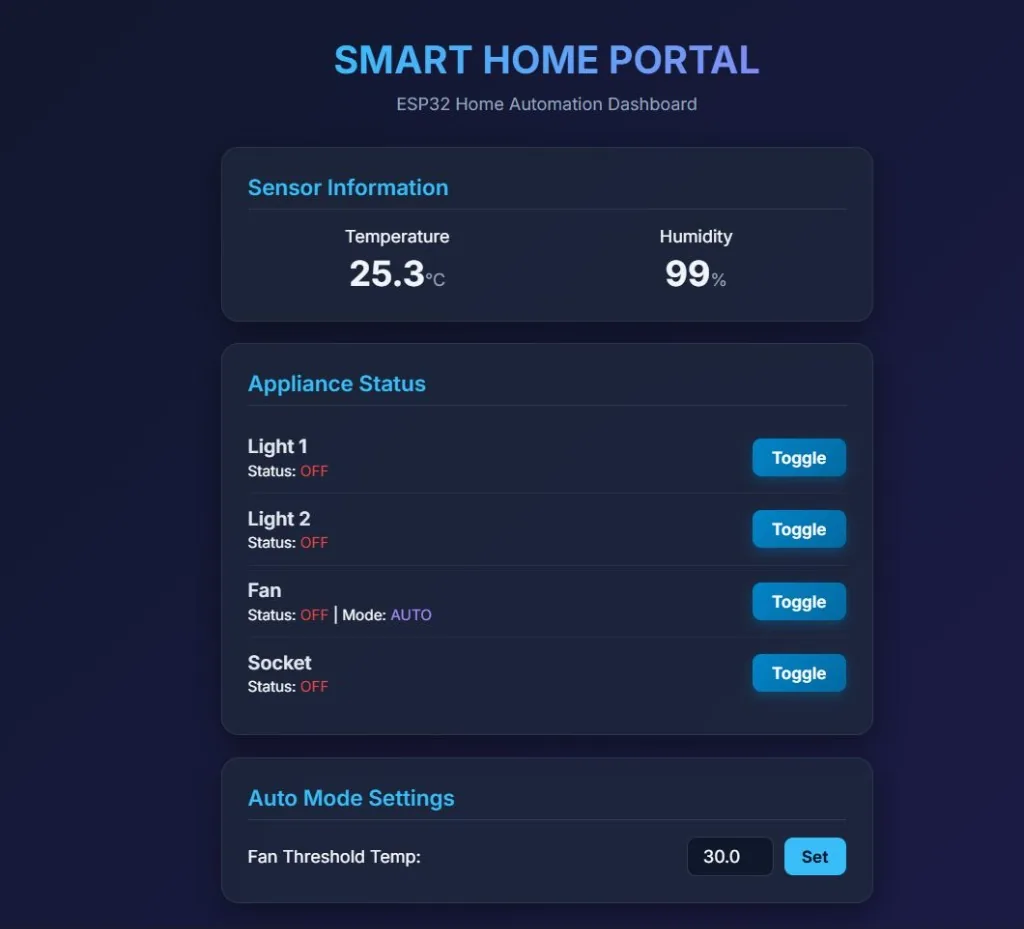
Smart Home Portal Web Interface
Custom ESP32-hosted web dashboard displaying real-time temperature, humidity, appliance toggles, and auto fan threshold controls.
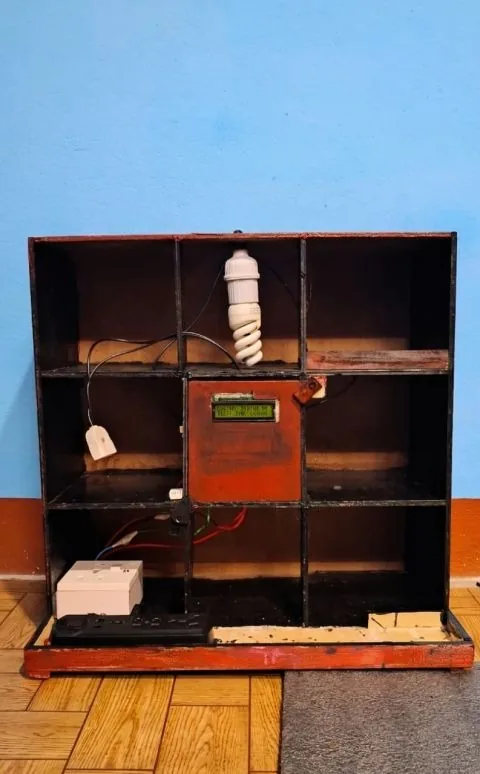
Physical Automation Model Setup
Complete 2nd-semester prototype enclosure featuring light bulb, central control unit with 1602 I2C LCD, and AC relay switching socket.
Auto Fan Control & LCD Feedback
DHT22 triggers the fan relay when temperature exceeds the set threshold; the onboard LCD provides instant hardware status.